Ancient & Medieval
Islay has been inhabited since the Neolithic period. Ancient Celtic ruins are scattered across the island.
3rd–5th century
Scots from the Irish kingdom of Dál Riata settled the island, establishing Gaelic language and Celtic culture on Islay.
800–1100 AD
Viking (Norse) invasion and rule. Norse placename elements survive to this day — for example, the "-aig" in Laphroaig is Old Norse for "bay."
12th–13th century
A prolonged territorial dispute between the Kingdom of Norway and the Kingdom of Scotland.
1266
Treaty of Perth — Islay formally becomes part of Scotland.
13th–15th century
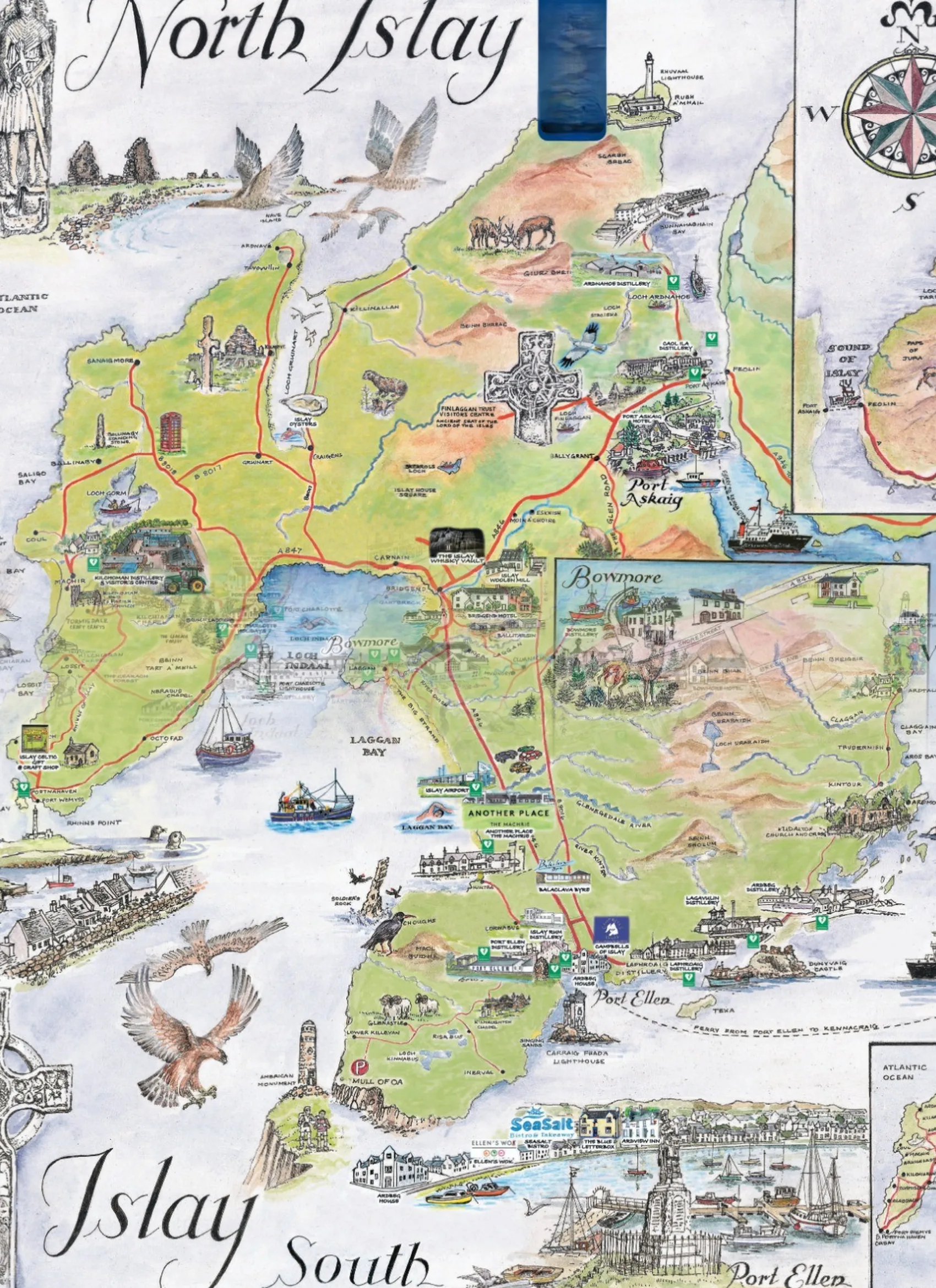
Islay serves as the seat of the Lordship of the Isles, one of the most powerful semi-independent polities in medieval Scotland. Finlaggan Castle on the island's central loch was its political and cultural hub, governing territory from the Hebrides to Ireland.
1493
King James IV of Scotland stripped the Lordship of the Isles of its powers. Islay subsequently came under the control of the Campbell clan (Earls of Argyll).
Finlaggan (Loch Finlaggan): The ruins of the castle complex survive on an island in the loch in central Islay and can be visited today — a remarkable trace of the Lordship's former power.
Modern Era
17th–18th century
Highland Clearances — landlords forcibly evicted tenant farmers across the Highlands and Islands. Many Islay families emigrated to Canada and the United States.
19th century
The legalisation of distilling (Excise Act 1823) transformed whisky into the economic backbone of the island, alongside agriculture and fishing.
World War I & II
Many young men from the island were conscripted. Population declined. Several distilleries halted production or converted to wartime industrial use.
Islay Today
Current population is approximately 3,200–3,400. The island has a single hospital and several schools.
- Main industries: whisky distilling, tourism, farming, fishing (shellfish and fin fish)
- Islay Malt is an established regional brand, drawing hundreds of thousands of visitors annually
- Fèis Ìle (late May) temporarily multiplies the population several times over — hotels and B&Bs sell out months in advance
- Much of the island is nature reserve; Islay is a known breeding site for white-tailed eagles
Language & Culture
Scottish Gaelic is still spoken by some residents. Most placenames are of Gaelic or Norse origin,
creating a distinctive cultural layering across the island's geography.
Toast: Slàinte mhath (pronounced "Slahn-ja va" or "Slànje") — "Good health" in Scottish Gaelic.
An essential phrase for any visit to an Islay distillery.