Ancient to Medieval: Origins of Distillation
The principle of distillation traces back to ancient Mesopotamia and Egypt, where it was used to extract perfumes and medicines. Arab alchemist Jābir ibn Hayyān (8th century) developed the "alembic" distillation apparatus. In the Islamic world, where alcohol was forbidden, distillation was used exclusively for medicines, perfumes and cosmetics.
10th–12th century
Arab knowledge spread to Europe via Crusades and trade routes. The medical school at Salerno, Italy, recorded techniques for distilling wine into aqua vitae ("water of life").
Origin of "Whisky"
Irish Christian monks acquired distillation techniques and brought them to Ireland and Scotland. The Gaelic uisce beatha ("water of life") became the word's origin: uisce → whishky → whisky.
1494
The Scottish Exchequer Rolls record: "eight bolls of malt to Friar John Cor wherewith to make aqua vitae." This is the earliest written record of Scotch whisky.
16th–17th Century: Taxation & Illicit Distilling
1560s
The Scottish Reformation dissolved the monasteries. Monks spread distilling skills to the general population; farmers began making their own spirits from surplus barley.
1644
The Scottish Parliament levied the first excise duty on whisky. Farmers retreated to the Highlands and islands; illicit distilling (poitin) became rampant.
18th Century: Union & the Height of Illicit Distilling
1707
Acts of Union — Great Britain formed. English excise law extended to Scotland, drastically raising duties. An estimated 14,000–20,000+ illicit stills were operating at the peak.
1725
The Malt Tax further intensified illicit distilling. Riots broke out across Scotland.
Early 19th Century: The Dawn of Legal Distilling
1823
Excise Act — the pivotal moment. Dramatic duty reductions and simplified licensing made legal distilling economically viable. George Smith founded The Glenlivet in 1824 — one of the first legal licensed distilleries in Scotland.
1831
Irish excise officer Aeneas Coffey patented the Coffey still (continuous still), enabling mass production of grain whisky at low cost. Ireland rejected it; Scotland adopted it — a decision that would define the divergence of the two industries.
Late 19th Century: The Blended Era & the Phylloxera Crisis
The technique of blending grain and malt whiskies was established. Johnnie Walker, Dewar's and Chivas Regal rose to prominence.
1860–1890s
The phylloxera louse devastated French vineyards. Cognac production collapsed, and Scotch filled the gap — becoming the status drink of the British gentleman and going global.
1898
Pattison's crash — the blending firm Pattison's collapsed in a fraud scandal, triggering a crisis of confidence and a wave of distillery closures.
Early 20th Century: Wars, Prohibition & Modernisation
1914–1918
World War I. The British government restricted grain use for the war effort. Most distilleries ceased production.
1920–1933
US Prohibition. Official exports halted, but smuggling thrived. After repeal, a flood of ex-bourbon barrels reached Scotland — permanently shaping the dominant maturation style of Scotch to this day.
Late 20th Century: The Whisky Lake & the Single Malt Revival
1983
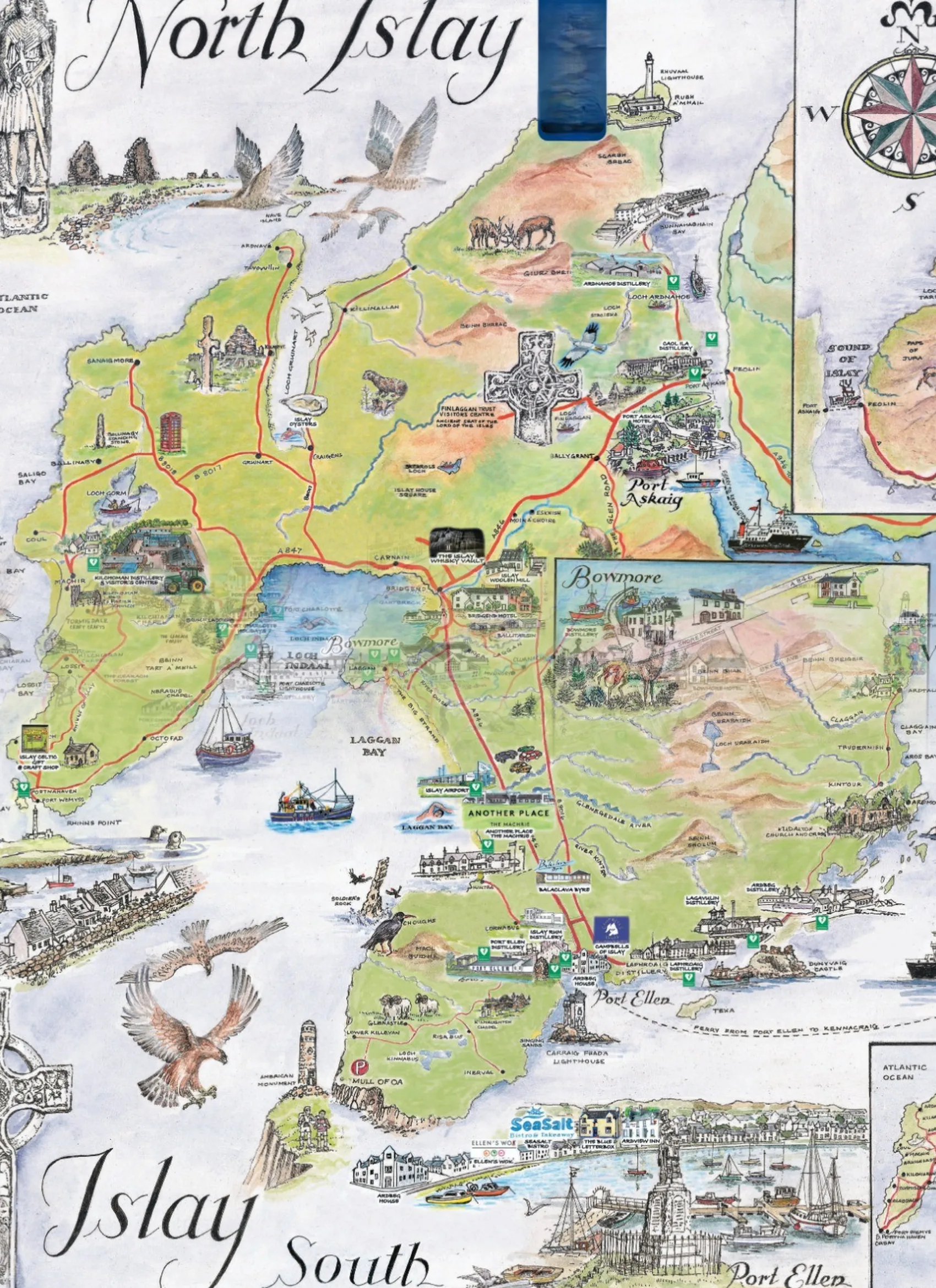
The "Whisky Loch" era — overproduction and falling demand. On Islay, Port Ellen and Brora closed. The industry-wide surplus of unsold stock was dubbed the "whisky lake."
1987
UDV (now Diageo) launched the Classic Malts series (including Lagavulin 16 Year). Single malts began to be marketed as premium brand products — Islay whiskies were at the forefront of this revival.
21st Century: The Craft Boom & Today
The global craft spirits boom of the 2010s saw new distilleries open on Islay (Ardnahoe, 2019). The 2023 reopening of Port Ellen and Brora was a historic industry event covered worldwide. Japanese whisky's global rise has driven up prices for both Scotch and Japanese rare releases.